

Design Systems That Help Early-Stage Products, Not Slow Them
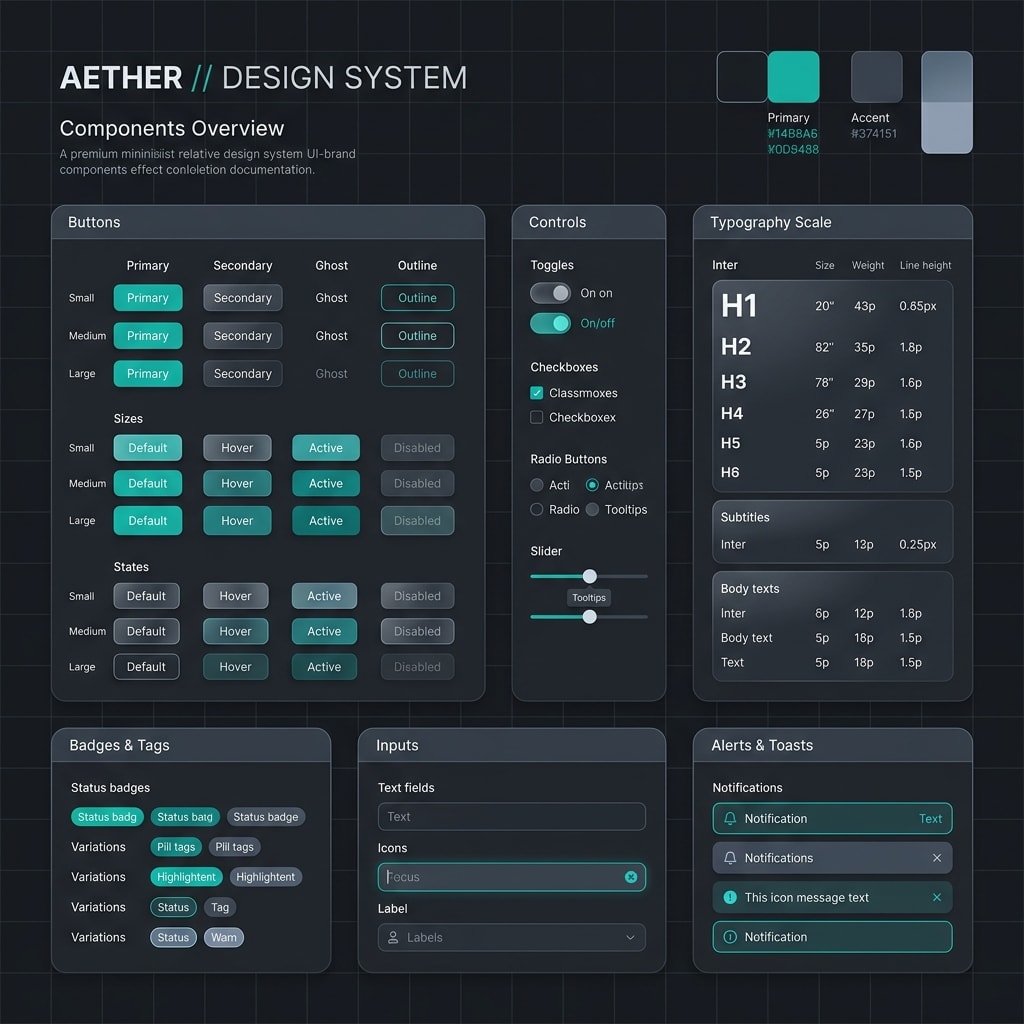
01The Timing Problem
Early teams often hear they need a design system on day one. We disagree with the timing, not the goal. Before product-market fit, your interface should change quickly; after PMF, inconsistency becomes expensive.
Investing too heavily in a design system early on can create rigidity where flexibility is needed most. You end up maintaining abstractions instead of building product features.
“A design system is not a Figma library. It is the contract between design and engineering about how decisions get reused.”
02Starting with Foundations
We start with foundations only: color, type, spacing, and motion rules tied to brand. Components stay small — buttons, inputs, cards, modals — and we resist building forty variants until usage patterns are obvious.
- Color ramps with accessible contrast pairs documented upfront
- Two type roles: display (brand) and mono (UI/data)
- Spacing scale in rem, never magic numbers in components
- Motion durations tied to purpose: feedback, transition, emphasis
By defining a solid set of design tokens in CSS variables or Tailwind config, you can change the entire look and feel of the application without rewriting components.
03Documentation is Key
Documentation lives beside code: Storybook or Ladle for interactive examples, plus a short README for when to reach for each primitive. Designers and engineers review the same source of truth weekly.
“If a developer rebuilds a button, that is not a discipline problem — it is a discoverability problem.”
04The Result
The result is a system that accelerates iteration instead of freezing it. You get cohesion without bureaucracy.
As the product matures, the system naturally scales. Components are hardened, variants are added, and the initial foundation supports the growth effortlessly.
- 01Week 1–4: tokens + 6 primitives
- 02Month 2–3: patterns for forms, tables, empty states
- 03Post-PMF: governance, versioning, contribution guide